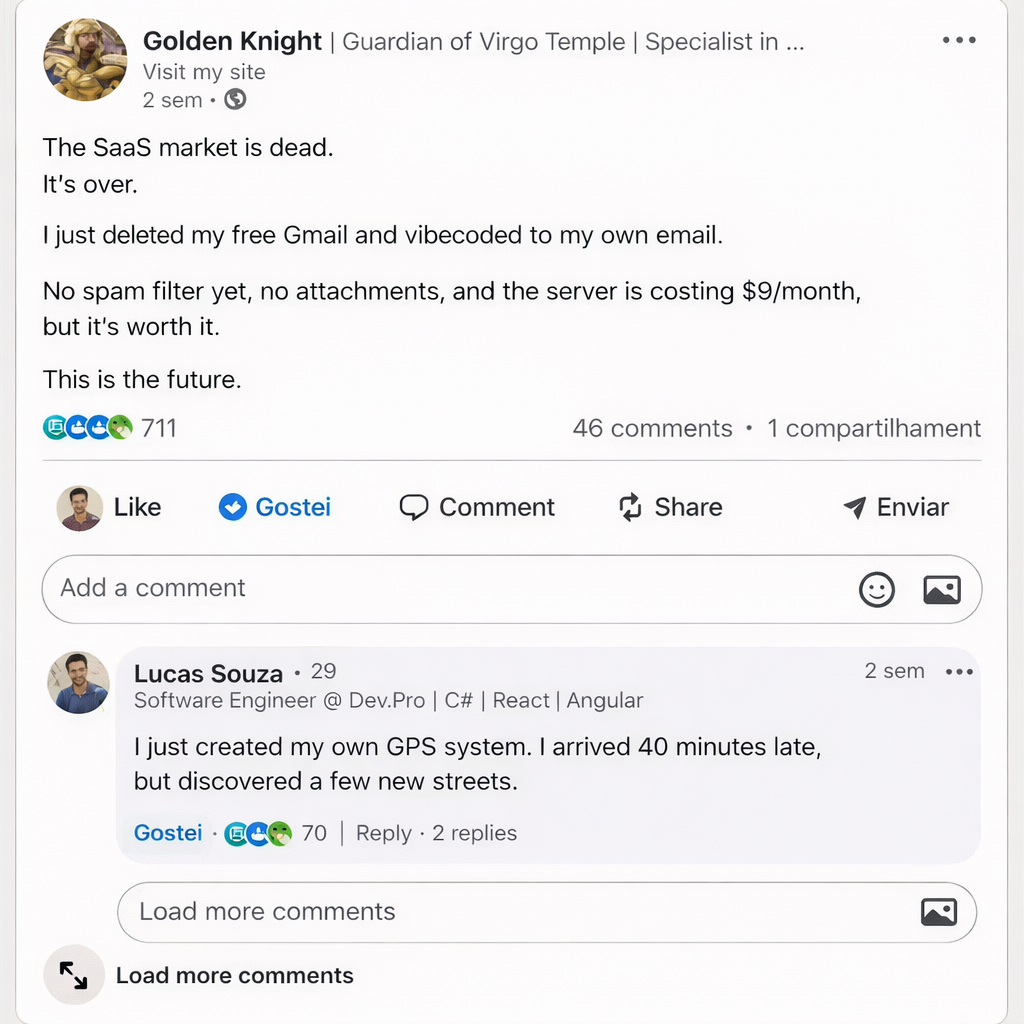
I’ve been seeing a lot of tech folks lately, including some people I actually like, claiming the death of SaaS. Honestly? They couldn’t be more wrong.
In short: it’s software you don’t actually own. You pay a monthly or annual subscription to access a service over the web, and in exchange, you get to use it anywhere. The benefits are clear: the company handles all the heavy lifting—fixes and improvements happen under the hood without you ever having to lift a finger.
When people say SaaS is dead, I don’t know what kind of SaaS they’re talking about, but I’m thinking of:
Resend is a SaaS focused on delivering transactional and marketing emails at scale, built for developers. So, if the model is dead, why on earth couldn’t I, or you, build the next Resend? The reality is isn’t just about the code.
Building a SaaS with real customers is about way more than just shipping code. There are a few “hidden” layers that people usually forget to bring to the table—until everything breaks, of course.
You will need to take care of the infrastructure. Architecture, deployment, databases, cloud providers, CI/CD pipelines—it’s a full-time job hidden inside your “simple” project.
If a SaaS is vital to your daily routine, “oops” isn’t an option. Imagine your cloud provider goes dark or a migration wipes your DB. You’ll be begging for (and crying without) a solid backup and a recovery plan. You need a solution that keeps running even when your own machine—or your luck—fails.
I could spend all day listing other requirements, like a mobile app or third-party integrations. But here’s the real deal-breaker: focus. Teams dedicated to a single product or ecosystem will always have more insights and better ideas than someone trying to do a million things at once. Sure, if your entire business is task management, go ahead and replicate a better Trello. But if it’s not your main job, why should you spend time on that?
I don’t think you are getting it. But maybe I’m wrong.
The argument is that with Claude Code and similar tools, you don’t even need a web interface for your SaaS anymore. You could just ask the AI to read your documents, run analyses, and give you answers. And sure, it can do that.
Do you honestly believe this is the kind of habit/product that will see mass adoption?
Do you really think people are going to pay $20, organize their own documents, craft the best prompts and delegate tasks to an AI just to get the job done instead of just log in to a plug-and-play solution where they don’t even have to think about how it works?
Honestly, I think some of you need to get out more and see how people who don’t eat Nvidia chips for lunch actually live and behave. We are in a bubble. If you don’t look outside of it, you’ll start analyzing possibilities in a way that is completely out of touch with reality.
YouTube channels have exploded, teaching people how to build a SaaS and claiming you could just quit your developer job and easily replace your income by launching your own product. If you aren’t a product person, it was never a possibility.
SaaS isn’t going to die. But this simplistic narrative, that you could just build any random SaaS and start printing money…I hope that dies. It’s about time.
So, a few SaaS ideas will die. Just a pretty spreadsheet? A tool that does nothing but basic data compilation? I think your end is near.
But make no mistake: this isn’t the end of a market, it’s just the end of the line for products that don’t add real value.
ACID is an acronym that represents a set of four important rules used in databases…
I see people saying Spec Driven Development is the way to produce good software using…
Foi mês de carnaval, e fazendo essa curadoria eu sempre fico pensativo em quanta coisa…
Comecei o ano de 2026 decidido a ler mais, estudar mais, ser mais focado. Desde…
Ganhei esse livro alguns natais atrás, comecei a ler 2 ou 3 vezes e parei.…
Toda vez que começa um novo ano eu fico pensativo sobre o quão genial é…